
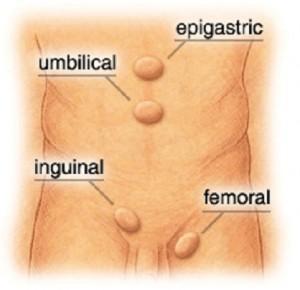
 An inguinal hernia or groin hernia is the most common type of hernia in adults. Inguinal or groin hernias are more common in men but they may also occur in women. With an inguinal hernia, abdominal contents, most commonly the small bowel (small intestine) or the omentum (a layer of fat that coats everyone’s abdominal cavity), can protrude through the hernia creating a lump or visible bulge. A hernia may cause discomfort or sometimes pain. Discomfort or pain from an inguinal hernia can be constant or may be sporadic, occurring once in a while. Discomfort or pain results when the small intestine or omentum gets caught in the hernia. Usually, the small bowel or omentum passes back though the hernia into the abdomen (reduces itself), and symptoms resolve. Occasionally, the small bowel or omentum gets stuck in the hernia, the hernia is then called incarcerated. If it is unable to be pushed back in, surgery is sometimes emergently needed, as the blood supply to the intestine may be compromised. Surgery is needed to reduce the intestine back into the abdomen before the intestine becomes strangulated (loss of its blood supply).
A femoral hernia is a type of groin hernia that occurs below the inguinal crease. The inguinal crease is the where the leg meets the abdomen in your abdominal wall. This type of hernia is less common than inguinal hernias but is, actually, more common in women. Femoral hernias have a higher likelihood of becoming to become stuck or strangulated. These hernias should almost always be repaired.
Umbilical hernias occur in or around the belly-button, or umbilicus. The belly button is an inherently weaker area of the abdominal wall, likely as a consequence of your umbilical cord coming from this area in utero. Eventually, the fascial layer of the abdominal wall can be worn away, resulting in a hole (a hernia) in the abdominal wall.
These hernias may occur in infants at or just after birth, and may resolve at 3 or 4 years of age. However, the area of weakness can persist or worsen throughout life, and can occur in men and women at any time, but most commonly in women after pregnancy. In adults, an umbilical hernia will not heal and go away on its own but may grow larger with time. Incarceration or strangulation may occur with an umbilical hernia.
Incisional hernias are hernias that can occur anywhere in the abdominal wall in an area where a prior surgery (a surgical wound) was performed.). When an incision is made through the abdominal wall for a surgery, that area is inherently weaker than other areas of the abdominal wall. Therefore, an incision has a higher chance of hernia formation. A hernia of this type usually presents with a bulge at or near the area of the prior surgery (a surgical wound). These hernias can appear weeks, months, or even years later, and can vary in size from small to very large. Incisional hernias usually may result from 1) poor wound healing whether from infection, obesity, poor nutrition, or certain medications (most commonly steroids), and 2) repeated wear and tear to the surgical incision. Incisional hernias may cause a bulge, discomfort, or pain.
Rarely, a ventral hernia (a hernia in the abdominal wall besides the groin and umbilicus) may develop without a previous abdominal incision (epigastric hernia is one type).